

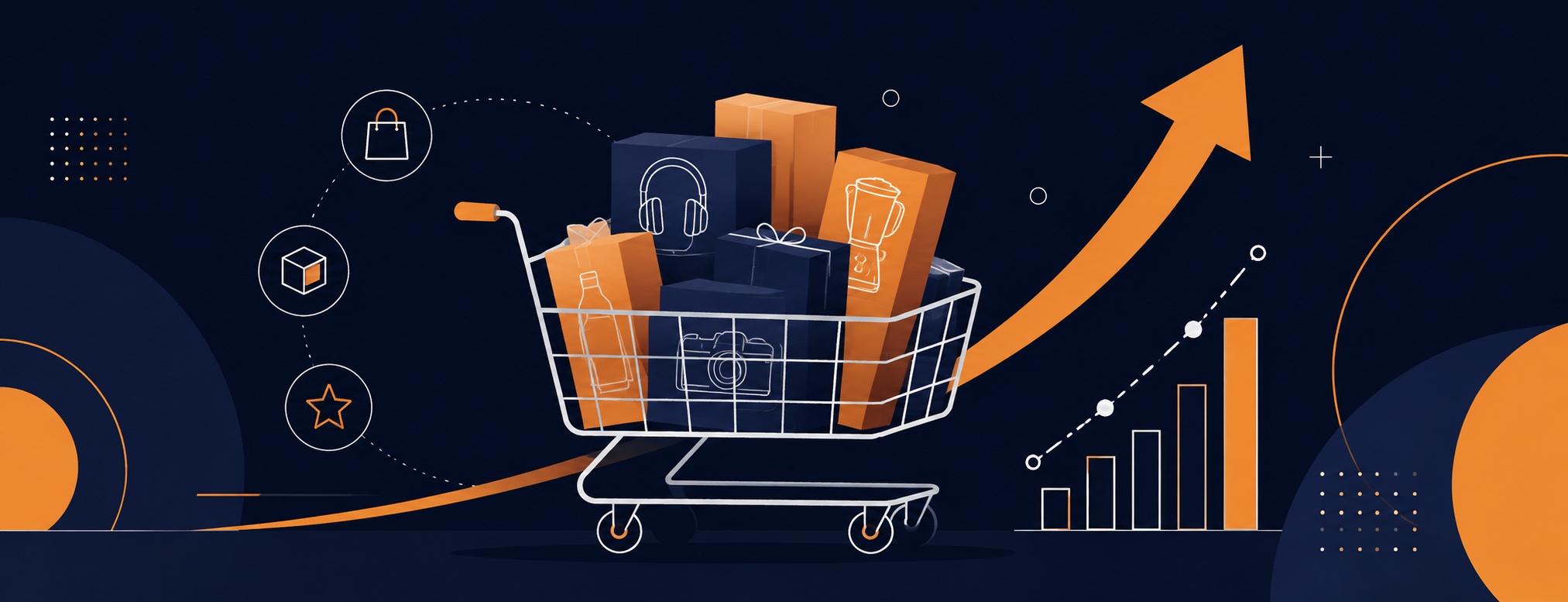
Most Shopify stores put 90% of their budget into acquiring a new customer and almost nothing into extracting more value from the order that's already in motion. It's the most expensive mistake in DTC ecommerce, and it has a fix that doesn't touch your acquisition budget.
AOV, average order value, is the most direct metric for growing profitability. Here are the concrete mechanics for moving it.
What is AOV, and why is it your most underused lever?
AOV (Average Order Value) is the simplest division in the world: total revenue divided by number of orders. If you generate €50,000 a month from 1,000 orders, your AOV is €50.
Raising that number by 20% has the same impact on your P&L as getting 20% more orders, without paying a single extra euro on Meta or Google. The acquisition cost is already paid. Nearly all of that extra margin falls straight to profit.
Yet most operators chase traffic volume and leave AOV to chance. It's the most underused lever in the direct channel, and the mechanics to activate it are well known. What's missing is systematic execution, not knowledge.
Bundles: sell more without the customer feeling like they're spending more
A well-designed bundle isn't a discount in disguise. It's a value proposition that makes the decision easier for the customer and more profitable for the store.
Three bundle types that work on Shopify
- Fixed bundle: a predefined combination of products at a single price. Works when there's an obvious pairing (the starter kit, the gift pack). Native to Shopify with variants, or with apps like Bundler.
- Dynamic bundle (mix-and-match): the customer picks N units or products from a selection. Ideal for consumables, cosmetics, and food. Increases the average order without forcing the customer to take something they don't want.
- Use-case kit: groups products by problem or moment, not by category. "Your first week of training kit" sells better than "Protein + shaker pack" because it speaks to an outcome.
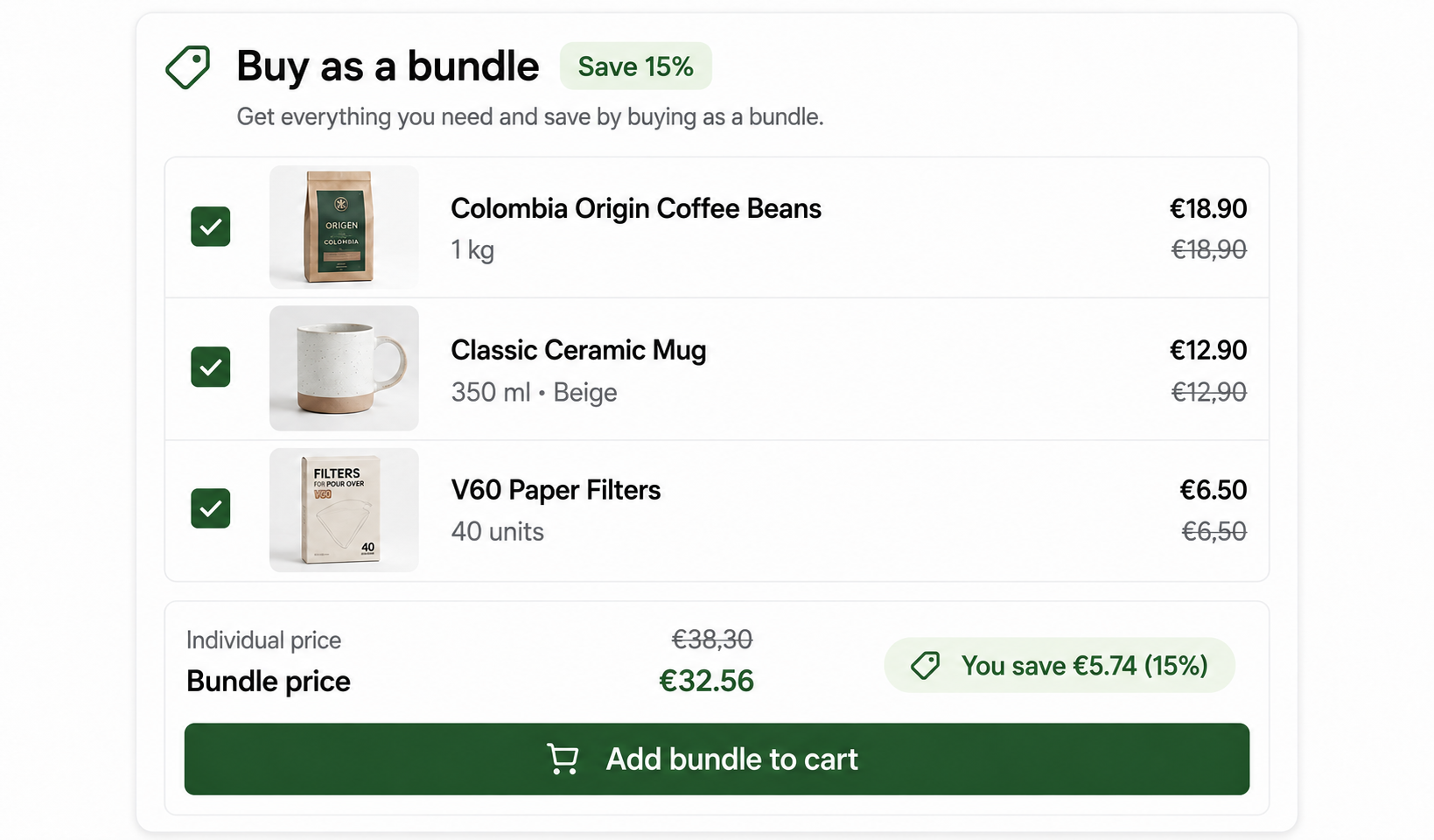
The most common mistake is slapping a 15% discount on the bundle and eating the margin for no reason. Test it first with no discount, or with a non-monetary perk instead: free shipping, a bonus sample, early access.
Upsells at the exact right moment: pre-purchase vs. post-purchase
Timing is everything. An upsell shown at the wrong moment interrupts the purchase. At the right moment, it amplifies it.
Pre-purchase: in the cart or at checkout
Shopify lets you add upsell blocks inside Checkout Extensibility. Show a single relevant offer, not a carousel. The rule: one product, one clear benefit, no friction to decline.
Post-purchase: the moment of highest trust
Right after confirming the order, the customer is at peak trust in your brand. It's the best moment for a one-click offer that doesn't require re-entering payment details. Apps like ReConvert or Zipify Pages let you build these thank-you pages with a built-in upsell.
The customer who just bought isn't in defense mode. They're in trust mode. That's where you need to be.
The key: the product you offer has to complement what they already bought, not substitute or distract from it. Relevance before margin.
Cross-sells: the art of suggestion that doesn't feel like selling
A cross-sell is the product recommendation that shows up naturally during the buying process. "Customers who bought this also bought..." is the best-known format, but also the most automated and generic.
The cross-sells that actually move AOV are the ones based on real behavior, not related collections. If your data shows that 40% of people who buy Product A end up buying Product B within the next 14 days, put that cross-sell in the cart or in the post-purchase email. You turn a future purchase into revenue from the current order.
To do this, you need to dig into your co-purchase data in Shopify order analytics or a tool like Lifetimely. A single day of work can translate into a sustained point of AOV.
The profitable cross-sell rule
If the suggested product doesn't lift the order's margin, or it complicates logistics without compensation, it's noise, not a cross-sell. Filter by margin, not just category affinity.
Post-purchase offers: the revenue most stores leave on the table
The order confirmation page reaches 100% of your buyers, and most stores use it to show an order number and a logo. It's one of the most wasted assets in ecommerce.
What you can do on that page:
- One-click upsell charged to the same payment method (requires Shopify Plus or a compatible app).
- Subscription offer if you sell consumables: turns a one-time purchase into recurring LTV.
- Referral with an immediate incentive: "Share this and your friend gets X, you get Y." The customer is at their most enthusiastic moment.
- Cross-sell with real urgency: limited stock on the complementary product, not a fake countdown.
Order confirmation emails see open rates between 60% and 80%. Including a relevant offer there, without cluttering the main message, is another layer of deferred AOV that very few stores activate. You can see how to structure these flows in our article on 7 email flows every Shopify brand needs.
Automations that scale AOV without manual work
AOV doesn't scale if it depends on someone remembering to turn on an offer every week. The mechanics that last are the ones that run on their own.
- Progressive free-shipping bar: shows the customer how much more they need to spend to hit the free-shipping threshold. One of the best effort-to-result ratios in AOV levers. Native to Shopify's cart block, or with apps like Gift Box.
- AI-based recommendations: Shopify Search and Discovery lets you configure recommendation rules by collection, tag, or history. More precise than generic blocks.
- Flows triggered by order value: Shopify Flow can fire off an email or internal task when an order crosses (or falls short of) a threshold. Useful for triggering personalized attention on high-value orders.
- Segmentation by historical AOV: split your buyers by average order value and treat them differently in campaigns. The customer who always spends €120 doesn't need the same message as the one who always stays at €40.
Automation doesn't replace strategy, but it does guarantee the strategy actually gets executed. You can dig deeper into this with our guide on Shopify retention metrics that actually matter.
The discount trap, and how to get out of it
Many stores confuse raising AOV with running volume discounts. "Buy 3, pay for 2" might bump the order value in the short term, but it trains the customer to wait for the deal and compresses margin exactly when you're selling the most units.
The alternative is adding value without cutting price:
- A free bonus sample once the order crosses a spending threshold.
- Early access to a new collection for orders above X.
- Free personalization or engraving on high-value gift orders.
- Free rush shipping on orders that beat your store's average order value.
These incentives carry a real cost, but they don't erode the customer's perception of the product's price. The operational difference is that the customer learns to buy more, not to buy on discount.
Raising AOV is about offering the right thing at the exact right moment and context, then automating it so it happens on every order without manual intervention. If you want to review how your store is structured to capture this potential, tell us where your business stands and we'll break it down together.

Juan Jüncter
Founder & Operator · ReadyCart
Founder of ReadyCart. Builds Shopify stores, runs Google and Meta spend, and sets up the measurement that makes every decision verifiable.
Work with ReadyCart

Get tactics like this every week
Practical content for Shopify brand owners who want to grow with strategy, not luck.