
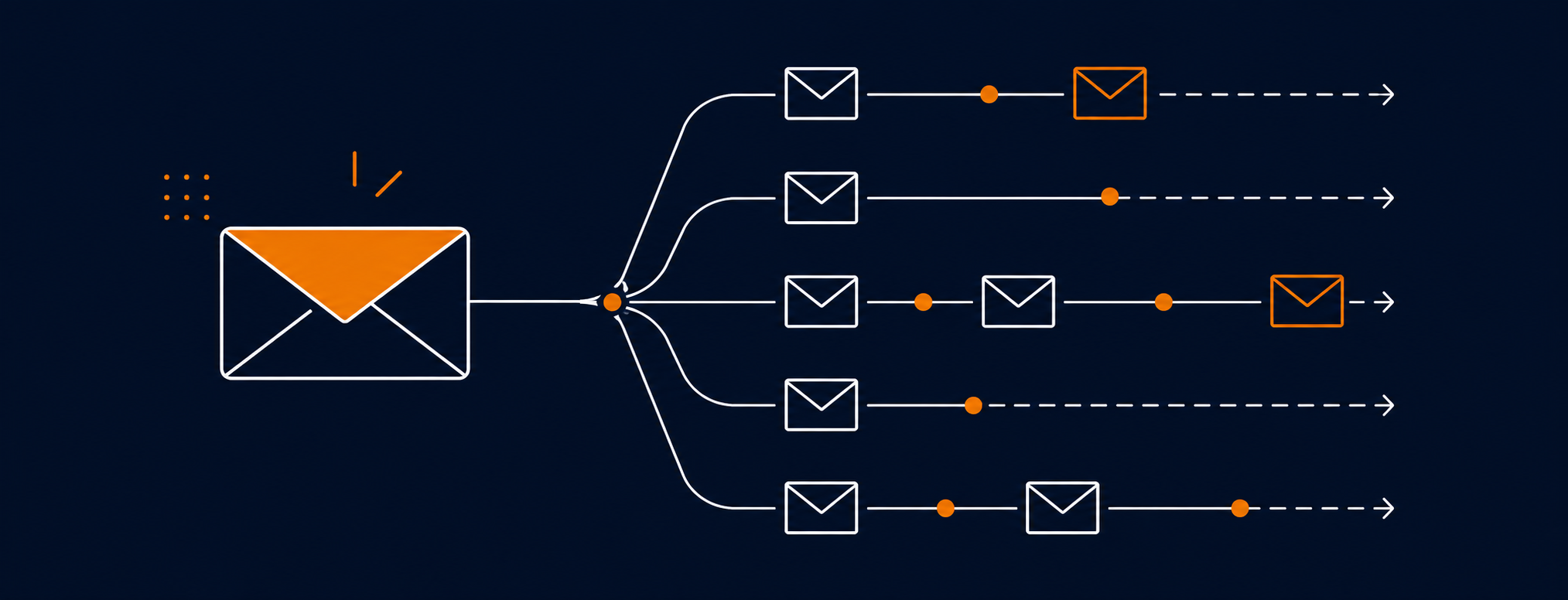
Most Shopify stores run email campaigns for Black Friday, the January sale, and not much else. They work hard for two weeks, send three emails in four days, then the channel goes quiet. Email isn't the problem. What's missing is a set of automated flows that run 365 days a year.
Email is still the highest-return channel in ecommerce, not because it’s cheap but because it reaches people who already raised their hand. The challenge is turning that attention into a machine, not a one-off campaign.
Why email still wins
While cost per click on Meta and Google keeps climbing, email sent to your own list has no CPC. Every well-built flow is infrastructure: you build it once and it generates revenue continuously. According to Klaviyo’s ecommerce benchmarks, automated flows typically drive 30% to 50% of total email revenue, for a fraction of the work manual campaigns require.
The problem we see in most stores isn’t the channel. It’s that they have one or two flows built halfway, unsegmented, never A/B tested, and untouched since launch. The result: money left on the table every week.
If your list keeps growing but your flows aren’t live, you’re filling a bucket with a hole in the bottom.
First impressions: the welcome flow
The welcome flow gets the highest open rate in your entire strategy. Someone just handed you their email, and their interest level is as high as it’s going to be for a long time. Capitalizing on that moment isn’t optional.
- Email 1 (immediate): deliver what you promised (discount, resource, access) and introduce the brand with a short, honest story.
- Email 2 (day 2-3): show your most relevant categories or products, backed by social proof, reviews, or real customer data.
- Email 3 (day 5-7): handle the main objection: price, product questions, return policy, whatever's holding back the first purchase.
Three well-written, well-timed emails outperform any monthly newsletter on conversion. If you don't have this flow live yet, start here.
Money on hold: cart and browse abandonment
These two flows are the most directly tied to recovered revenue. Cart abandonment targets people who reached checkout and didn't buy. Browse abandonment comes earlier, catching someone who viewed a product page but didn't add anything to cart.
Cart abandonment
- Email 1 (1 hour): a simple, no-pressure reminder. Direct button back to the cart.
- Email 2 (24 hours): show the product in more detail, include buyer ratings.
- Email 3 (48-72 hours): real urgency, not manufactured. If stock is limited, say so. If you can offer an incentive, this is the moment.
Browse abandonment
This requires active tracking and a segment already identified in your email platform. A single email sent 1 to 4 hours after the visit, showing the viewed product and a reason to come back, can recover between 2% and 5% of those lost sessions. For accurate measurement of these interactions, check out our guide on GA4, Meta CAPI, and UTMs for reliable tracking.
The sale doesn’t end at checkout
The post-purchase moment carries the highest trust. The customer just bet on your brand. What you do in the next 7 to 14 days decides whether they come back or forget about you.
- Order confirmation: beyond Shopify's automatic transactional email, a branded confirmation with a human tone improves perception from the start.
- Usage or onboarding email: if your product needs some kind of activation, instructions, or context to deliver results, this is the place for it. It reduces returns and increases satisfaction.
- Review request (day 10-14): the best moment to ask for feedback. Tie this flow into our guide on Shopify retention metrics that actually matter.
- Smart cross-sell: don't offer the same product they just bought. Use your catalog data to recommend something complementary that actually makes sense.
The post-purchase flow as an AOV lever
A well-segmented cross-sell in the post-purchase flow can raise average order value without acquiring a single new customer. Pair it with bundles to multiply the effect.
Win back or let go
An inactive subscriber isn’t a lost customer, but they’re not an asset either. If it’s been more than 90 days since someone opened one of your emails, you need a win-back sequence before it starts hurting your deliverability.
- Email 1: a direct subject line that acknowledges the distance. No tricks, no drama. Just a clear reason to come back.
- Email 2 (3-5 days later): a real incentive, if your margins allow it. An exclusive discount for inactive subscribers can win back between 5% and 15% of the segment.
- Email 3: the last attempt. If they don't respond to this one, clean the segment. A smaller, engaged list is worth far more than a large, cold one.
Cleaning your list is operational hygiene, not giving up. It improves your open rate, your domain reputation, and your real performance metrics.
Purchases that repeat themselves: replenishment and VIP
If you sell consumable products, replenishment is the highest-return flow in your entire automation library. Calculate the average product lifecycle and send the reminder 5 to 7 days before it runs out. The customer already knows they need it. They just need the nudge.
The VIP flow is different: it’s not a reminder, it’s recognition. Segment your best customers by purchase frequency or total spend and give them early access to launches, exclusive discounts, or content that isn’t available to everyone else. Perceived exclusivity builds loyalty without needing aggressive discounts. To understand how to structure these value levers, check out our guide on increasing AOV with bundles, upsells, and automations.
How to prioritize and measure your flows
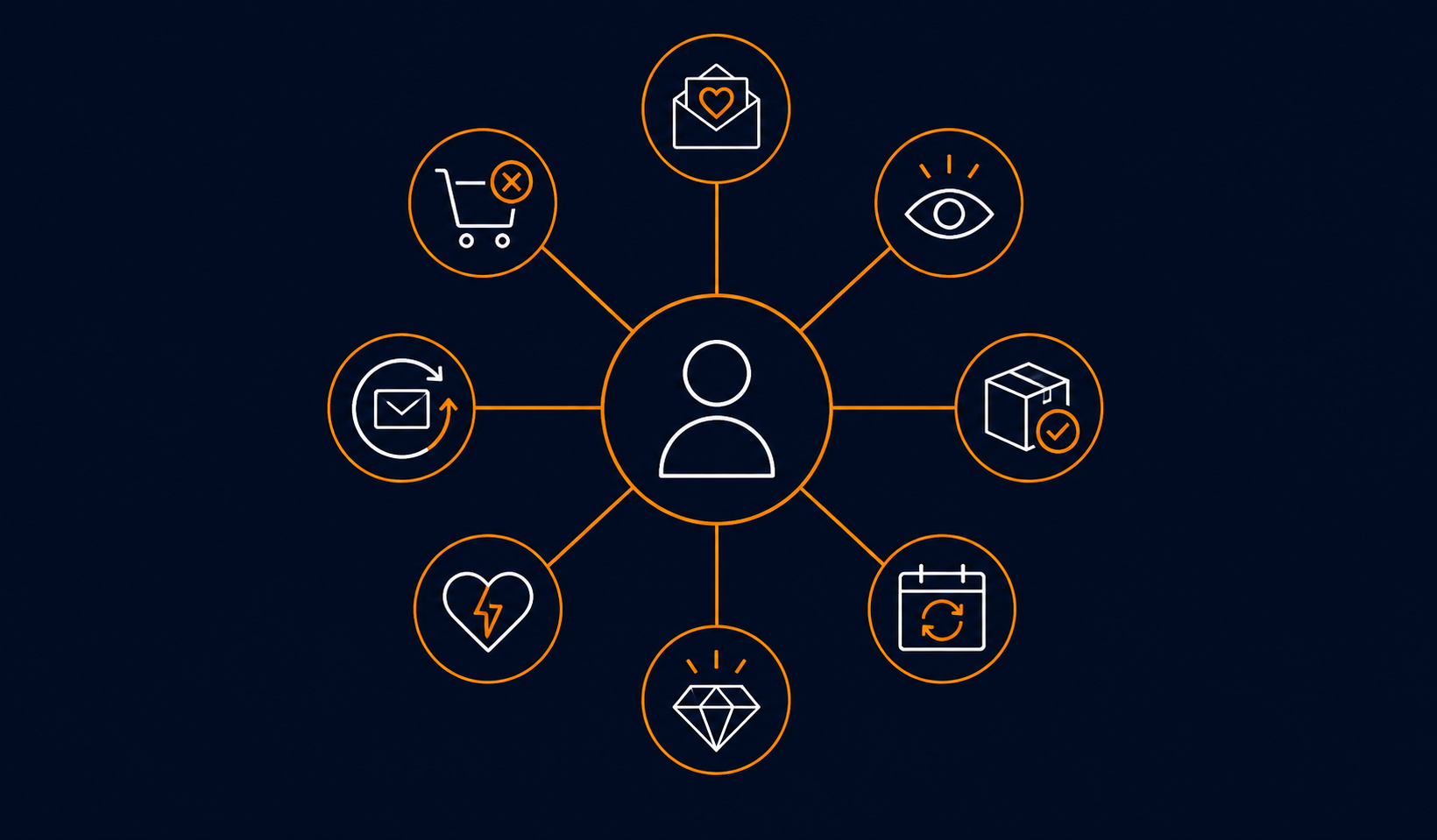
If you’re starting from zero, the optimal rollout order is: welcome, cart abandonment, post-purchase, win-back, browse abandonment, replenishment, and VIP. The first three generate the highest revenue volume for most stores.
The metrics that matter per flow:
- Open rate: signals subject line relevance and list health.
- Click rate: measures whether the content and offer connect with the segment.
- Revenue per email sent: the definitive metric for comparing flows against each other.
- Flow conversion rate: how many subscribers who entered the flow ended up buying.
Review your flows at least once a quarter. Prices change, the catalog evolves, segments shift. A flow that hasn't been touched in 18 months might be sending outdated prices or recommending discontinued products.
Seven well-calibrated flows can out-earn your entire manual campaign strategy combined. Not because email is magic, but because it runs nonstop, on the right segment, at the right time. If you want to audit your current flows or build this infrastructure from scratch, tell us where you stand and we’ll tell you where to start.

Juan Jüncter
Founder & Operator · ReadyCart
Founder of ReadyCart. Builds Shopify stores, runs Google and Meta spend, and sets up the measurement that makes every decision verifiable.
Work with ReadyCart
Get tactics like this every week
Practical content for Shopify brand owners who want to grow with strategy, not luck.