


There are Shopify stores that have spent months optimizing their campaigns on data that lies to them. They increase budget on what looks like it's working, cut what looks like it's failing, and week after week, results don't improve. The problem isn't the creative or the targeting. It's the foundation: a broken measurement stack reporting a reality that doesn't exist.
This guide covers the three pillars that build reliable analytics for DTC stores: GA4 configured correctly, Meta CAPI active, and UTMs applied with discipline. Without all three in order, any investment decision is little more than a bet.
Why your current analytics is probably lying to you
The problem isn't that GA4 or Meta Ads are bad. The problem is that most stores install them with the default configuration and assume the data is correct. It isn't.
The most common symptoms of broken analytics are: duplicate conversions in GA4, orders that don't show up in Meta despite having closed, inflated direct traffic because email campaigns aren't tagged with UTMs, or Meta ROAS that doesn't match Shopify's actual revenue. When you see these symptoms, it's not a campaign performance problem. It's a data problem.
The first step, before touching any budget, is to audit your measurement layer.
GA4 configured right: the minimum for a Shopify store
Shopify has native integration with GA4 through the Google and YouTube app. The problem is that the standard integration doesn't always fire events correctly, and the dataLayer Shopify generates has nuances worth reviewing.
The three critical events you need to verify before anything else are:
- purchase: must include transaction_id, value, currency, items. Check that it doesn't duplicate when the confirmation page reloads.
- begin_checkout: should fire only once when entering checkout, not on every step.
- add_to_cart: must correctly capture item_id, item_name, and price, without double-firing on variants with quick selection.
To audit the dataLayer, use the DataLayer Checker extension or Google Tag Manager's debug mode. Filter by ecommerce events and check that all parameters are arriving complete. A transaction_id that arrives empty or is always the same value is the most common cause of duplicates in GA4.
GA4 conversions vs. Google Ads conversions
If you use Google Ads, import conversions from GA4 instead of installing a separate Ads conversion tag. You avoid double counting and keep a single source of truth. Set the conversion window based on your actual purchase cycle: if your average order value is over 100 euros, a 30-day window is reasonable.
Meta CAPI and the problem with browser-only tracking
The Meta pixel runs in the user's browser. That worked fine for years. But since iOS 14 and the rise of ad blockers, somewhere between 20 and 40 percent of conversions never reach Meta this way. The result: Meta undervalues your campaign performance, the bidding algorithm gets less signal, and the ROAS you see in Ads Manager doesn't reflect reality.
If Meta doesn't know you made a sale, it can't learn from it. The algorithm optimizes for what it sees, not what actually happened.
The Conversions API (CAPI) fixes this. Instead of relying on the browser, it sends conversion events directly from your server to Meta. Shopify has native CAPI integration through the Meta app. Turn it on, map the events you want to send, and check in Event Manager that events show an Event Match Quality (EMQ) score above 6 out of 10. Below that threshold, the signal is too weak for the algorithm to use.
The parameters that boost match quality the most are hashed email and phone number. Shopify includes them automatically if the customer completed checkout with that information.
Check Event Match Quality before you scale
Go to Meta Events Manager, select the Purchase event, and check the EMQ score. If it's below 6, add more customer parameters before increasing budget. A weak signal drives up your cost per result.
UTMs: the convention that saves your attribution
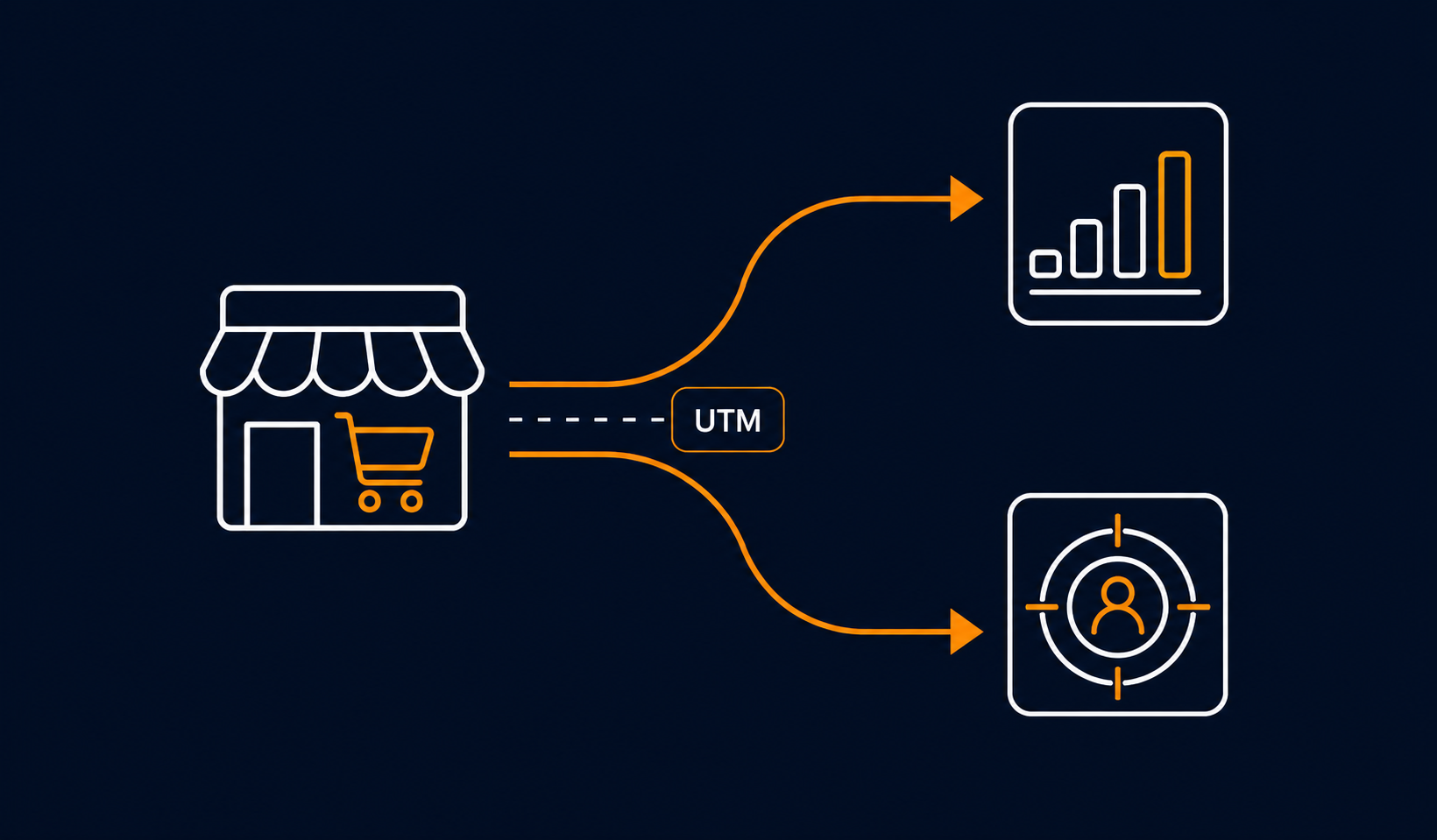
A missing or badly set UTM destroys attribution in GA4. Untagged traffic piles up under the "direct" source, which in most stores shows up artificially inflated because emails, WhatsApp messages, and organic posts don't carry parameters.
The minimum convention you need to apply consistently is:
- utm_source: identifies the traffic origin (meta, google, klaviyo, instagram, etc.).
- utm_medium: identifies the channel (cpc, email, social, sms).
- utm_campaign: identifies the specific campaign (bf2024, q1-reactivation, summer-collection-launch).
- utm_content: distinguishes creatives or variants within the same campaign.
The most common mistake is using different names for the same channel depending on who creates the link. If utm_source is "Facebook" one month and "facebook-ads" the next, GA4 treats them as two separate sources and your acquisition report gets fragmented. Define the convention in a shared document and enforce it on every link your team creates.
For Meta and Google ads, use dynamic parameters: utm_campaign={{campaign.name}} fills in automatically with the real campaign name. You avoid manual errors and keep granularity without extra effort.
Deduplication: when the same order shows up twice
When you have the Meta pixel and CAPI active at the same time, the risk is that the same purchase event arrives twice: once from the browser and once from the server. Meta deduplicates automatically if you pass it the same event_id on both channels.
In Shopify, the event_id you should use for deduplication is the order number or the checkout token. Meta's native Shopify integration handles this on its own if it's configured correctly, but it's worth verifying in Event Manager. Look for events with the "Deduplicated" indicator in the Purchase event detail. If you don't see that indicator, you're probably counting double conversions.
The same principle applies if you use both the Google Ads tag and GA4 to report conversions: pick one source and turn off the other. Two sources counting the same thing doesn't give you more information, just more noise.
Attribution models: what each one tells you
The attribution model decides which channel gets credit for a sale when the customer interacted with more than one. There's no perfect model. Each one tells a different story.
- Last click: all the credit goes to the last channel before the purchase. Favors branded search and retargeting campaigns. Undervalues prospecting.
- Data-driven (GA4): distributes credit based on the real statistical impact of each interaction. It's the most reliable option once you have enough conversion volume (more than 300 per month).
- Meta attribution: Meta measures within its own silo. It will always report more conversions than GA4 because it counts ad views, not just clicks. Use it to optimize within Meta, not to compare channels against each other.
The practical recommendation is to use data-driven in GA4 as your source of truth for comparing channels, and each platform's native attribution to optimize campaigns within that platform. Don't try to make the numbers match exactly: they never will.
Audit checklist: 10 points to check before trusting your data with a decision
Before making any investment decision based on your data, run through this list. If any point fails, fix it before scaling budget.
- The purchase event in GA4 includes a unique transaction_id, value, and currency on every order.
- There are no duplicate conversions in GA4 when the confirmation page reloads.
- The begin_checkout event fires only once per checkout session.
- Meta CAPI is active and Event Manager shows Purchase events with EMQ above 6.
- Meta deduplication works: browser and server events share the same event_id.
- All paid campaign links carry UTMs with consistent naming.
- Klaviyo or your ESP's emails carry utm_source, utm_medium, and utm_campaign on every link.
- Direct traffic in GA4 accounts for less than 15 percent of the total. If it's higher, you have untagged sources.
- Google Ads conversions are imported from GA4, not from a separate tag.
- The attribution model in GA4 is set to data-driven (or last click if you have fewer than 300 monthly conversions).
A reliable measurement stack isn't a one-day project, but it isn't a months-long one either. With a week of focused work, you can get all three pillars in order. From there, every investment decision rests on data that reflects what actually happened.
A reliable stack is the prerequisite for any investment decision that isn't a blind bet. If you want us to review your analytics before you scale, book a growth call and we'll look at it together.

Juan Jüncter
Founder & Operator · ReadyCart
Founder of ReadyCart. Builds Shopify stores, runs Google and Meta spend, and sets up the measurement that makes every decision verifiable.
Work with ReadyCart


Get tactics like this every week
Practical content for Shopify brand owners who want to grow with strategy, not luck.